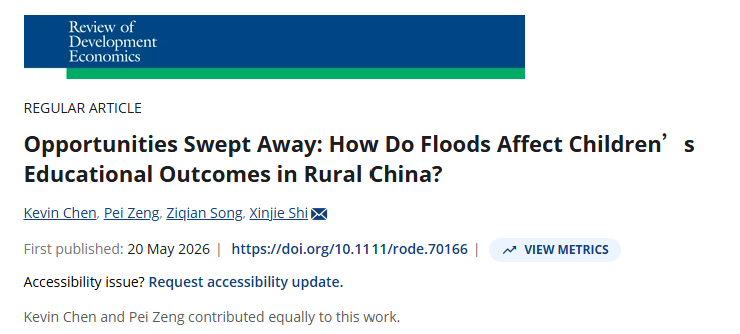
近日,浙江大学公共管理学院求是讲席教授陈志钢、史新杰长聘副教授与博士生曾培、伊利诺伊大学厄巴纳-香槟分校(UIUC)博士生宋子谦的合作论文“Opportunities Swept Away: How Do Floods Affect Children’s Educational Outcomes in Rural China?”在国际期刊Review of Development Economics在线发表。
文章概要:
随着气候变化加剧,自然灾害发生频率持续上升,洪涝灾害已成为影响发展中国家农村地区人力资本积累的重要风险。1998年中国爆发的特大洪水波及范围广、冲击强度高,为理解灾害冲击如何影响农村儿童人力资本积累提供了研究场景。
本文将1998年全国性洪水视为准自然实验,通过匹配县级降水异常数据与人口普查数据,采用队列双重差分识别了洪水暴露对农村儿童教育结果的影响。研究发现,洪水冲击显著降低了农村儿童继续接受高中教育的概率,一地1998年日均降水量每异常增加1毫米,农村个体就读高中的概率下降约1.5个百分点。异质性分析表明,洪水造成的教育机会损失在女性群体中更为明显,而较高的父母受教育程度则能够缓解这种负面影响。这说明自然灾害不仅会减少农村儿童教育机会,还可能扩大农村地区教育的性别差距,并削弱教育代际流动。
机制分析表明,洪水一方面显著增加了农村家庭的生活压力,使家庭减少对子女教育的投入;另一方面,为应对收入损失,农民外出务工的可能性进一步提高,从而增加儿童留守的概率,并损害其教育获得。值得注意的是,1998年洪水后,中国政府提高了灾区教育经费、基础设施建设和农业发展等投入,有效缓解了洪水对农村儿童长期教育结果的负面影响。据此文章强调,灾后救助政策不仅需要关注灾害的短期损失,也应将留守儿童照护和农村家庭生计韧性纳入政策考量。
英文摘要
The frequency of natural disasters has surged globally in recent years. However, the existing literature paid limited attention to the role of government and individual disaster response strategies on shaping human capital outcomes in disaster-affected populations. This paper uses the 1998 nationwide floods in China as a quasi-natural experiment to estimate the loss of educational opportunities for rural children exposed to natural disasters. By matching county-level precipitation anomaly data with the 2010 census data, the difference-in-difference analysis showed that individuals in early life stages (ages 7-15) in rural areas exposed to stronger floods experienced a significant reduction in educational opportunities. This negative impact of the 1998 China floods on educational opportunities was more pronounced among females and impeded intergenerational mobility in rural areas. The mechanism behind this finding is twofold. First, the impact of flooding increased the burden on rural households and reduced their investment in their children's education, with this deprivation effect being particularly pronounced in areas more dependent on the primary sector. Second, due to early experiences of flooding, there is an increased likelihood of parents migrating to cities for work. While the potential increase in income may have positive effects, the negative impact of leaving children behind tends to dominate. However, post-disaster investment in education and infrastructures from the government helped mitigate the long-term negative impacts of the floods to some extent. This paper re-emphasizes the negative impacts of natural disasters on human capital accumulation, elucidating the different response behaviors of the government and farm households, contributing to understanding the impact of different actors' responses to natural disasters on the long-term human capital accumulation of the offspring, providing a reference for post-disaster relief efforts in countries or regions in transition.
原文链接
Chen, K., P. Zeng, Z. Song, and X. Shi. 2026. “Opportunities Swept Away: How Do Floods Affect Children’s Educational Outcomes in Rural China?.” Review of Development Economics1–30. https://doi.org/10.1111/rode.70166.