Urbanization is a historical process characterized by the ruralpopulation to urban migration and concentration, which means the transfer of thegeographical position, the change of career, the evolution of production and the way of life. China is promoting urbanization to increase domestic demand and improve productivity to stimulate the economy.During the process of continuing and accelerated urbanization, more and more peasants have moved and are moving tothe city which has increased the urbanization ratio(the ratio of the population in urban areas to the entire population). However, there are huge differences in economic, social, cultural and political rights and benefits between rural migrant workers and urban residents in the cities.This paper explains the necessity of urbanization and a new type of urbanization moving forward. The paper alsoargues that the citizenization of rural migrant workers is the key to realize the “true” urbanization in Chinain which the same rights enjoyed by urban residents will be given to rural migrant workers and the family members living with them. This paper proposed a path forward to accelerate the citizenization in China.
Necessity of urbanization in China
Although the urbanization ratio in China rose from 17.9% in 1978—immediately before the start of China's reform and open-door policies—to 54% in 2014, it is still low compared not only with that of developed countries, but also with that of other developing countries at a similar stage of growth, suggesting that there is plenty of room for growth. With export growth slowing down in recent years against the backdrop of the global economic crisis and the rise of protectionism, the government is hopeful that urbanization will help sustain economic growth by expanding domestic demand and improving productivity.
First, the real estate economy has been a key driver for the economic growth in China. However, the real estate market in China has been sluggish in recent yearsdue to the overdevelopment in urban areas. For example, the average number of houses per urban resident household in Shanghai is 2.4 while lots of houses still need to be sold. During the process of urbanization, the government hopes more and more farmers will move to the cities and buy houses which will stimulate the real estate market in China.
Second, urbanization will increase consumption demand. Reflecting the fact that productivity in the manufacturing and service industries, which are mainly located in urban areas, is much higher than that in the agricultural sector, the per capita income of urban residents is about three times that of rural residents. In proportion to this, the consumption gap between urban areas and rural areas is also significant due to the staggering wage differences. Along with the advancement of urbanization, consumption will grow as increasingly more farmers become urban residents.
Also, urbanization will create huge investment demand, particularly in infrastructure (electricity, water, roads, communications, gas and thermal, waste and sewage treatments, etc.) and public service facilities (schools and hospitals, etc.).
Urbanization will also help modernize agriculture and pressure agricultural development. If a large number of farmers leave farming villages and obtain jobs in non-agricultural sectors through urbanization, their income from non-agricultural sources will increase. Their agricultural income will also climb in tandem with higher productivity. Using the increase in rural disposable income and decrease in population, farmers will be pushed to invest into large-scale agriculture run by higher technology like the farming seen in most modern nations. In addition, because land prices in farming villages near cities will rise due to the boom in the urban real estate market, local governments and farmers will be able to make a profit by selling their land.
New Type of Urbanization
Until now, urbanization in China has been deemed to be the equivalent of building cities. The emphasis has been on the expansion of a city's area and size, while improving the people's standard of living has not been the major concern. Rural migrant workers in particular are regarded simply as part of the labor force, and they and their family members are not treated as real "citizens."
The State Council issued a guideline on Feb 6, 2016 to promote the construction of a new type of urbanization. The new type of urbanization is an inevitable path to modernization and realizing the potential in domestic demand, an important driver for economic development and a major livelihood project. It calls for overall planning and coordinated development between towns and cities of all sizes, thus improving the quality of overall urbanization.
Implementation of household registration system reform policies and improvement of basic public services covering all residents is another facet of the guideline. Household registration has been a hot topic of controversy, discrimination, and discussion. The guideline strives to simplify the household registration system so it is easier for a migrant worker with a job and kids to obtain household registration (aka. Hukou).
This new type of urbanization also urges the renovation of shantytowns, villages in cities, and dilapidated houses, as well as the construction of a comprehensive transportation network, underground pipeline network, sponge cities, and new types of cities. To further encourage mutualistic progress in all regions, it called for the cultivation of medium and small cities and small towns with characteristics and city clusters. The new type of urbanization will exert a ripple effect to promote the development of a new countryside, boosting the expansion of infrastructure and public services to rural areas and integrated development of primary, secondary and tertiary industries and e-commerce in rural areas.
The guideline also called for the improvement of the land use mechanism and urban housing system, as well as innovation of the financing mechanism to support the building of the new type of urbanization.
Citizenization of migrant workers as key for China's rural urbanization
To accelerate the urbanization with Chinese characteristics, which can achieve reasonable and
healthy urbanization, China must now focus on promoting the citizenization of migrant workers.There are two steps in the transformation from farmers toresidents in the cities 1) from agriculture to non-agricultural transformation, and 2) from migrant workers (non-agriculture) to residents in the cities. Because of the special large number of Chinese farmers, the process will be very long and the cost will be very high. However, the migrant workers have already completed the first step – leaving the farm behind. The quality of all aspects and the ability of working and living in the city also have been greatly improved. Compared with peasants that are engaged in agriculture, migrant workers not only can accelerate the process of urbanization to make the migrant workers achieve a permanent non-agricultural state, but also they can decrease the cost of citizenization, making urban integration less difficult and more easy. In contrast, letting farmers that are engaged in agriculture realize citizenization is more difficult. Not only does China need to create more employment opportunities to compensate the risk of going into city, but also major citiesmust commit to the improvement of citizenization and improve the quality of life for migrant workers in the city to set an example for those who haven’t left their fields. So the costs of taking this route are higher and this process lasts far longer.Therefore, it is imperative to primarily direct focus on aiding migrant workers already present in cities. With their success comes inspiration that will bring the rural pack at home to cities.
There are currently more than 100 million migrant workers who have realized non-agricultural progressionbut have not realized the citizenization of migrant workers, which indicates Chineseurbanization still lags behind the industrialization. If cities help them attaincitizenization, notonly can Chinaachieve the national goal of an urbanization ratio of about 60% in 2020, but also they can reduce theadditional cost of the citizenization of farmers, which is conducive to achieving moderatesynchronized advancement of urbanization and industrialization.
Connotation of citizenization of China's migrant workers
With the acceleration of social and economic transformation, the surplus rural labor force is moving into cities in the form of migrant workers. Many of them live and work in the cities most of the time of each year. They have close relationships with the city, and are an integral part of the city. However, the nation iswitnessing the marginalization of migrant workersbecause they are not being granted urban household (Hukou); therefore, they are not “truly” urban residents although they live in the city. Migrant workers are suffering all kinds of discrimination. There is no guarantee of the rights and interests for migrant workers, and crime rates of migrant workers are increasing with each passing day. These phenomena have directly caused the urban-rural conflicts to a large degree. Based on the reality of the migrant workers living conditions and its adverse effect on overall coordinated development between urban and rural areas, the citizenization of migrant workers is one of the biggest challenges for the Chinese government.
The citizenization of migrant workers is a process in which rural migrant workers leap over various obstacles and gradually transform into urban citizens. It includes transformation on four levels: occupation, social identity, self-cultivation, and ideology/life style.
Accelerating citizenization of rural migrant workers
The urbanization ratio continues to increase up to this day.The table shows the percentage of Chinese population living in urban areas until 2014 taken from the National Bureau of Statistics of China.
Table 1. The percentage of Chinese population living in urban areas until 2014.
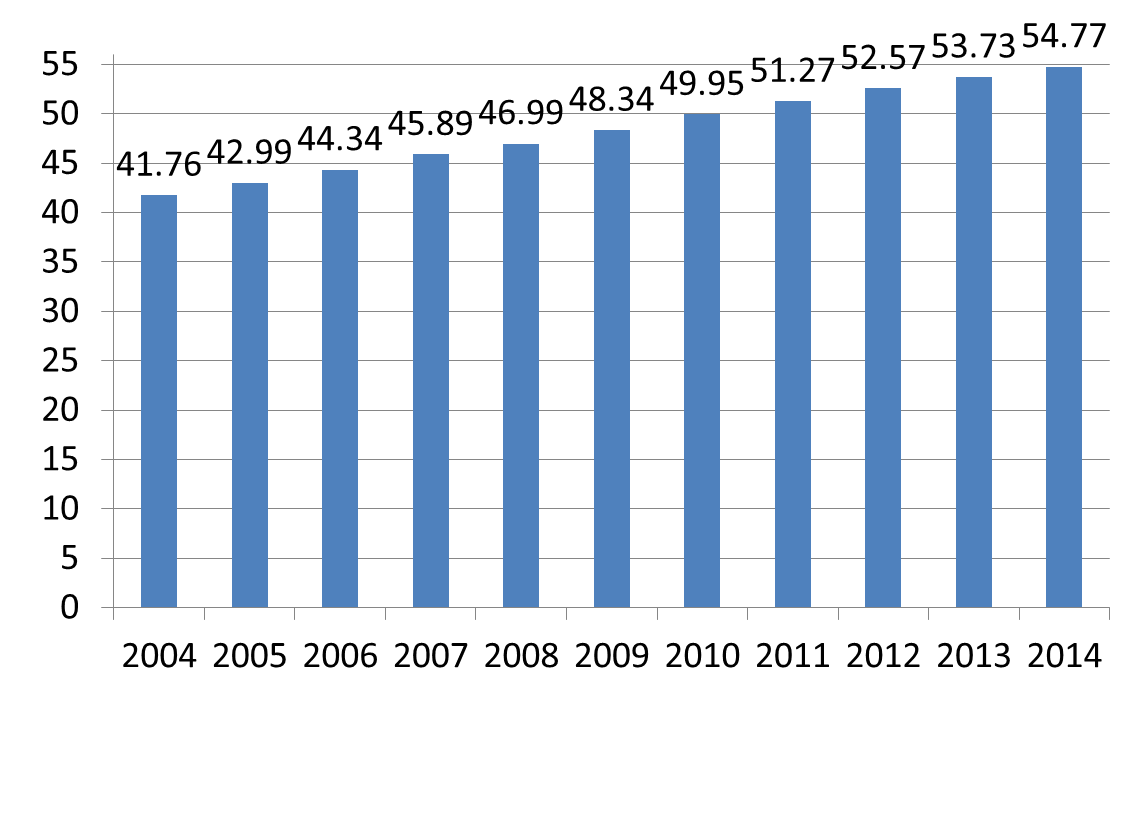
Household registration in China is divided into rural and non-rural (urban) types. In 2014, about 54 percent of the total population lived in cities. Among those who lived in cities, about 50% of them have not acquired urban household registrations and remain registered as rural households. Because of the restrictions related to household registration and other associated systems, these people can hardly enjoy the same rights to which residents with urban household registrations are entitled: suffrage, social security, and compulsory education.
The government is carrying out further reform, along with its 2016 national guideline, through its 6-year new national urbanization plan (2014-2020). Based on a policy of gradually promoting citizenization with measures that take into consideration actual conditions, the city governments are progressing towards a system that will grant urban household registrations to those rural migrant workers with stable jobs, as well as to their family members living with them. Those rural migrant workers who have met these requirementssettle into the city and enjoy the same rights and fulfill the same obligations as urban residents do. The national government encourages local governments to further lower urbanization hurdles, except for a handful of large cities, allowing the transfer of agricultural population settled in the place of employment and prioritizing students,army members, urban residents for over 5 years, skilled workers, returned overseas students, andthe new generation of migrant workers.
The national plan also clearly mentions a concrete and systematic method and goal for speeding up the adjustment and improvement of mega-cities household registrations policy.
1) Except for the mega-cities, other cities cannot take measures that require the purchase of housing, investment tax, and credit accumulation system to restrict urban household registrations.
2) Based on the overall carrying capacity and functions of the city, the city is divided up into regional urban, suburban, and developmental areas. The policy for granting urban household registrations to those rural migrant workers will differ based on where they will be settled.
3) Children of migrant workers have equal academic opportunities.
4) Rural migrant workers who maintain a stable employment relationship with a company are eligible for the basic pension system and medical insurance provided for urban employees.
5) City governments have financial incentives for urbanization—they allow rural migrants to hold onto their rural land when attain urban citizenship.
6) The central budget for investment arrangements favors cities that have great potential for urbanization and development.
Overall, there are many reasons that urbanization stands as such a major issue and topic. First, improving the efficiency of city-migration responds the voices of many frustrated citizens. The holder of a residence permit in a residential district guarantee enjoyment of compulsory education, basic public employment services, basic public health services and family planning services, public cultural and sports services, legal aid and legal services as well as other basic public services prescribed by the State. They do not need to go back their hometown to apply for all kinds of certificates and can apply in the local city as urban residents do: immigration certificates in accordance with relevant state regulations, renewal and replacement of identity cards, vehicle registration, driving license, enrollment in vocational qualifications and apply for a grant professional qualification and other facilities. Second, urbanization reform paves way for China’s economy to continue growing at its astonishing rate. Giving a largely discriminated but capable population provides a large boom in human capital that will allow China’s drive to modernization to surge with a new flame. Through national urbanization efforts, China can make another great leap forward.
References
1. Chen, T and Huang, Z. Imbalance in urban and rural relationships and its impact on sustainable development in China. Proceeding of New York Conference on Asian Studies (NYCAS). 2015
2. Chen, T and Huang, Z. Citizenization of Rural Migrant Workers in the Process of China’s Urbanization. Proceeding of Southeast Conference on Asian Studies (SEC/AAS) 2016
3. Tian, T. Study on the citizenization of migrant workers. Journal of Tianzhong (in Chinese). 2015:30(6)
4. http://finance.sina.com.cn/chnia/gncj/2016-02-06/doc-ifxpfhzk9027729.shtml
5. http://www.rieti.go.jp/en/china/13011101.html
6. Chen, L., Qiao, J., Jie, L. The study on citizenization of migrant workers in the process of China's urbanization. Proceeding of 2nd International Conference on Management Science and Industrial Engineering (MSIE 2013)
7. Jane, X., He, Z., Huang, Kun. The road of urbanization with Chinese characteristics
urbanization, Shandong people's press. (2010)
8. Zhang, Y. and Gao,Y. Study on the citizenization of migrant workers based on human capital training, Rural Economy and Science Technology.2012(2)
9. National Bureau of Statistics of China. China Statistics Yearbook 2014[M]. Beijing: ChinaStatistics Publishing House. 2014 (in Chinese)